
The Intelligence Trap
Why Africa’s Brightest Minds Quietly Defend Its Most Broken Institutions

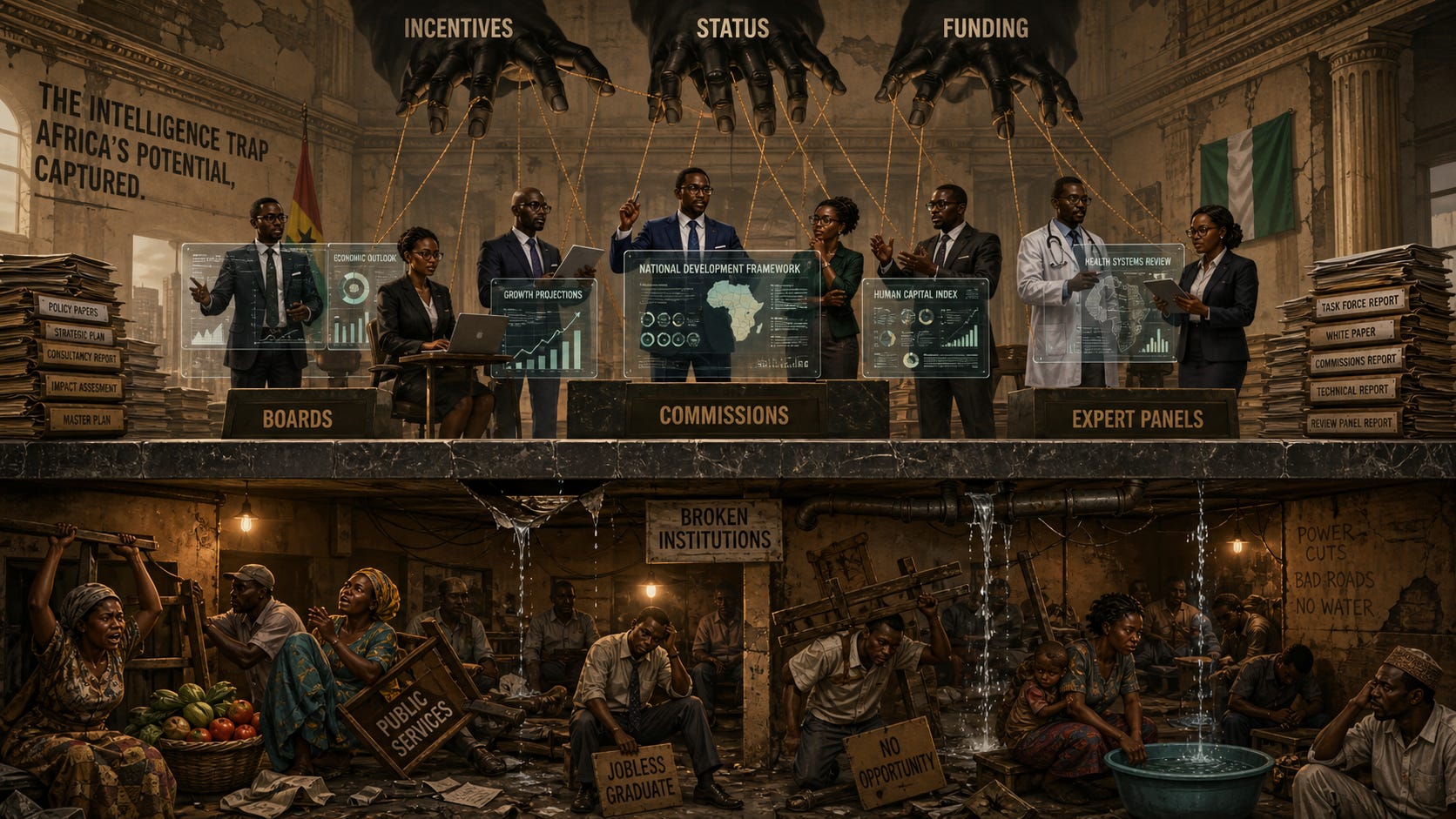
We have been taught to worry about the wrong people. The fear we are sold from primary school onwards is that the ignorant and the unqualified might end up running our institutions and ruining them through sheer incompetence. The actual record of how Ghana, Nigeria, Kenya, and much of the continent has been governed for the last sixty years tells a very different story.
Our worst institutions have not been run by uneducated people. They have been run by some of the most brilliant minds the continent has ever produced. PhDs from Harvard, Oxford, and the London School of Economics. Chartered accountants, senior advocates, Doctor of Philosophy. Men and women whose intellectual gifts would be the pride of any society in the world.
Our worst institutions have not been run by uneducated people. They have been run by some of the most brilliant minds the continent has ever produced.
And yet these institutions remain broken. Most of them have been broken for longer than the people currently running them have been alive. The threat is not a shortage of intelligence in Africa. The threat is intelligence that has been quietly captured. Captured by incentives, by status, by board memberships, by conference invitations, and by the slow comfort of belonging to an expert class that asks very few hard questions about itself.
This includes, it should be said in fairness, the intelligence of whoever is making this argument.
Intelligence Is Not Independence
There is a flattering story we tell about smart people. That they are more rational than the rest of us, less biased, better able to follow the evidence wherever it leads. The story is mostly wrong.
What high intelligence actually gives a person is a much better toolkit for rationalization. The poorly educated man defends a failed government policy with slogans, party colors, and tribal loyalty. The brilliant economist defends the same policy with regression models, citations, and the borrowed vocabulary of whatever intellectual tradition his employer pays him to inhabit. The conclusion is identical. The packaging is just more impressive.
Research by Jonathan Haidt and others has shown that political and moral reasoning is almost always backward in its construction. We arrive at our conclusions first, shaped by self-interest, identity, and who signs our pay slip. Only then do we construct the arguments to justify them. The smarter we are, the more polished those justifications become.
This does not mean smart people are always wrong. It means the correlation between intelligence and institutional loyalty is far stronger than the smart people themselves would willingly admit.
The Ghana School of Law and the Habit of Closing the Door
If you want to see credentialism defending itself in Ghana, watch what happens around the Ghana School of Law admission examination every single year.
Thousands of qualified university graduates with law degrees from accredited institutions are denied admission. Pass rates have at times been scandalously low. Each year, the same brilliant lawyers and academics who control the system explain, often with great care and patience, why this is necessary for quality, for professional standards, for protecting the public from incompetent practitioners.
The economic logic underneath the explanation is much simpler than the explanation itself. The fewer lawyers admitted to practice, the higher the fees the admitted lawyers can charge. The system that controls entry is run by the very people who benefit from restricted entry. This is not a unique Ghanaian failing. It is the universal pattern of any credentialing system left to be run by the credentialed.
The same logic operates in medicine, in engineering, accountancy, and pharmacy. Each profession defends its restrictions on entry by appealing to public safety. Each profession quietly grows wealthier the more restricted that entry becomes. And each is full of brilliant people who would be deeply offended at the suggestion that their professional advocacy has anything to do with their own income.
The economist Joseph Stiglitz won a Nobel Prize for showing that in markets where buyers cannot easily judge quality, certification can serve a genuine purpose. He was not wrong. What his framework also predicts, when followed honestly, is exactly the capture problem we see across professional Ghana. When the certifiers and the certified are the same people, the system stops measuring competence and starts measuring compliance with whoever holds the gate.
When Markets Capture, the Failure Looks the Same
Honesty requires me to turn the argument against my own intellectual tradition here. Otherwise, the rest of this essay is just performance.
Private markets are not magically immune to this problem. The credit rating agencies, Moody’s, Standard and Poor’s, and Fitch, are private companies operating in competitive markets. In the years before the 2008 collapse, they rated mortgage-backed securities stuffed with toxic loans as AAA, the highest possible grade, implying near-zero default risk. They were not government bureaucrats. They were brilliant private analysts whose entire business model depended on being paid by the very issuers whose products they were rating.
Closer to home, Ghana watched a version of this in the banking sector cleanup of 2017 and 2018. Several local banks collapsed despite carrying audited financial statements signed by reputable auditing firms. The auditors had not failed for lack of intelligence. They had failed because their fees came from the same banks whose accounts they were certifying. The conflict was structural, not personal. And it cost ordinary Ghanaian depositors billions of cedis.
Friedrich Hayek’s defense of market processes against central planning remains powerful and correct. Markets aggregate dispersed information that no central authority can possess. But Hayek’s argument is about the superiority of market processes over command-and-control planning. It is not guaranteed that every institution operating in a market is immune to the capture described in this essay.
A market can correctly allocate most of its resources and still produce a rating agency that calls toxic debt safe, or an audit firm that signs off on books it cannot reasonably defend. Conflating these two failure modes weakens both arguments. Honest analysis has to keep them apart.
When Failure Becomes Funding
In a real competitive market, failure carries consequences. The business that consistently produces a poor product loses customers and eventually closes. In the African expert class, failure operates very differently.
When a program collapses, the lesson is almost never that the program should end. The conclusion is always that the program needs more resources, better leadership, a new framework, perhaps a fresh commission to oversee the previous commission. Failure does not shrink the expert’s jurisdiction. It expands it. The administrative budget rarely shrinks because of poor results. It grows in response to them.
Ghana has been to the International Monetary Fund seventeen times since independence. Each visit was led by some of the most brilliant Ghanaian economists alive at the time. Each visit was justified by analyses, projections, and policy frameworks of considerable technical sophistication. And each visit was followed, within a decade or so, by another visit, often led by the same class of economist, defending the next set of structural adjustments.
There has never been a shortage of intelligence in Ghanaian economic policy. There has been a sustained, structural inability of the economic policy class to ever recommend its own reduction in scope or authority. The technocrats who designed the policies that put Ghana back in the IMF’s waiting room are often the same technocrats negotiating the new IMF program. The think tank that recommended the failed intervention publishes the post-mortem analyzing the failure. The professor who advised the previous administration quietly takes a seat with the next one.
A century ago, Julien Benda described this kind of betrayal in his essay The Treason of the Intellectuals. He was writing about a clerisy that had abandoned disinterested inquiry to serve class interest and institutional power. What he called treason in his time is now simply a career track in ours. The betrayal does not happen in a single dramatic moment. It happens grant by grant, consultancy contract by consultancy contract, conference invitation by conference invitation, until it is completely invisible to the person committing it.
Complexity as Camouflage
When institutional defenders begin losing the argument on its merits, the standard response is to make the argument more complicated.
The Bank of Ghana does not have a loss problem. It faces, in the words of its own communications, a challenging interaction of monetary policy operations, sterilization costs, valuation effects, and structural balance sheet considerations. The school that produces illiterate graduates does not have a failure. It has a multidimensional interaction of socio-economic variables, infrastructural deficits, and policy implementation gaps. The state-owned enterprise that burns through public funds does not have a mismanagement issue. It has a unique operating environment requiring nuanced policy support.
Some of that language reflects genuine complexity. The world really is complicated, and pretending otherwise is its own kind of motivated reasoning. But the tell is the asymmetry of when the complexity is invoked. Institutions reach for complicated language precisely when they are being criticized. They reach for plain language when they are claiming credit. A success is always a clear and direct outcome of expert policy. A failure is always a multifaceted phenomenon requiring further study.
Mises described this dynamic with unusual precision in Interventionism: An Economic Analysis. Each intervention creates distortions, and those distortions appear to require further interventions to correct. The expert class whose authority grows in response to these distortions is the very class whose previous interventions created them. The complexity is not incidental. It is load-bearing. It is what keeps the entire system in business.
The Argument Has to Turn on Itself
The intellectual tradition this essay draws from, skeptical of concentrated authority, of expert consensus, of institutional permanence, is not exempt from the dynamic it describes.
Austrian and libertarian commentary has its own publications, its own funders, its own audiences whose comfortable assumptions it would be professionally inconvenient to challenge. If the central claim of this essay is correct, that experts systematically rationalize in favor of the institutions that sustain them, then it has to be a claim about human incentives in general. It cannot be a partisan accusation aimed only at the people the writer happens to disagree with.
What would falsify the thesis? If credentialed insiders regularly and voluntarily recused their own institutional authority in response to failure, if they dissolved programs that did not work, if they recommended deregulation of their own fields, that would be a serious problem for the argument. Such examples do exist. They are rare enough to be remarkable, and that rarity is itself the evidence the argument is asking us to weigh.
Conclusions
Intelligence held by someone who is genuinely free to use it is formidable. It builds companies, advances science, treats the sick, defends the falsely accused. It is one of the most valuable resources a continent like ours has to draw on.
Intelligence held by someone whose income, identity, and social standing all depend on a particular set of institutions remaining respectable is something else entirely. It is the most sophisticated defense attorney any broken African system has ever had. It is the most expensive obstacle to honest reform that we have ever paid for.
The danger across the continent is not that brilliant people cannot see what is wrong with our institutions. The danger is that they are intelligent enough to explain, in sophisticated and patient language, exactly why nothing is really wrong. And occasionally, in their quieter moments, they are honest enough with themselves to catch what they are doing.
Whether they say it out loud is a different question, and the answer to that question is what will eventually decide whether the next sixty years on this continent look anything different from the last.
I wish everyone a pleasant and productive day.

Thank you for your continued support. For concise weekly analysis rooted in free-market economics, I encourage you to remain subscribed and to share this newsletter with colleagues. I am Samuel Frimpong, an economist and writer dedicated to defending free trade and economic rationality.
By 2026, you can expect increased consistency in publication. I will continue to publish regularly and uphold the standards you value: clear arguments, rigorous reasoning, and a commitment to principles rather than propaganda.
Disclaimer: You are receiving this newsletter because you subscribed. If you no longer find value in these updates, you may unsubscribe at any time. This content does not constitute financial advice. Please conduct your own research.